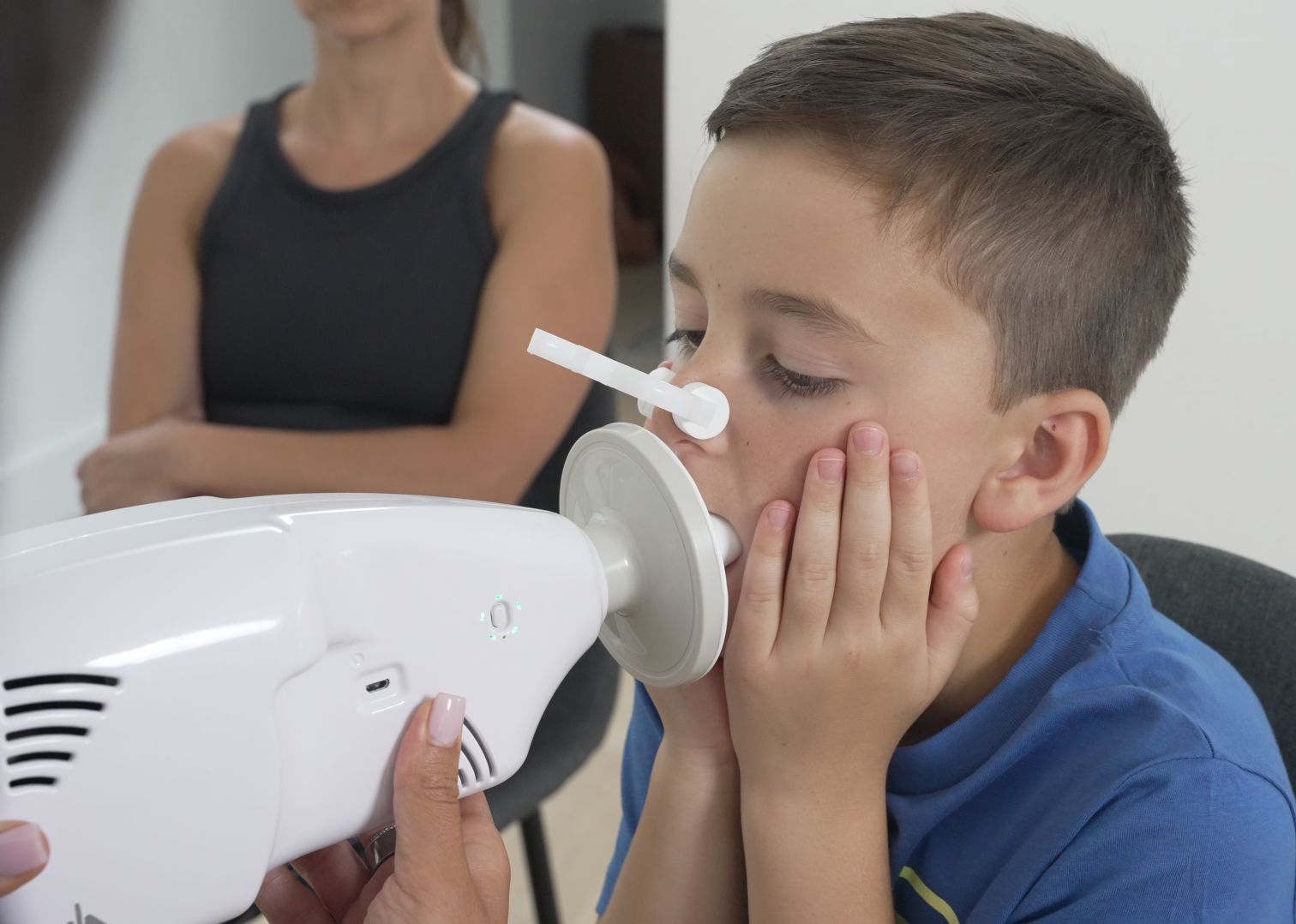
The Patient Presents as Healthy Overall – But Decline Starts Quietly
A child who gets winded too quickly. An adult who underreports shortness of breath. A lingering cough that doesn’t meet formal criteria for referral. This is how early lung function decline shows up – not as a loud siren, but often as a whisper.
In pediatrics, primary care, and even asthma clinics, declining lung health often evades detection. Symptoms emerge slowly. Patients downplay them. And clinicians lean toward watchful waiting – not out of neglect, but because the tools to investigate those suspicions don’t fit the realities of daily care.
Our Tools Just Don’t Fit Clinicians know lung health matters. But spirometry asks a lot:
Expert coaching fromRoutine spirometry can be challenging for most patients, particularly our vulnerable patients – children, elderly, and high disease severity.trained respiratory therapists
Multiple repeated efforts
Extra training and time
Poor fit for younger or harder-to-test patients
Many teams don’t have that capacity in-house. And even when performed correctly, most spirometry tests miss small-airway decline – the type that creeps in quietly, without pronounced symptoms.
So the test gets skipped or tossed out. The condition gets missed. Not because the clinician didn’t care – but because the available tools weren’t built for routine care environments.
Why Early Respiratory Screening Matters
Early lung function decline is subtle, but clinically serious
Patients normalize symptoms until the disease has progressed
Delayed diagnosis means delayed treatment, worse outcomes, and higher costs
Over 60% of adults with moderate obstruction report no known respiratory diagnosis
The problem isn’t awareness – it’s the lack of a tool that fits the rhythm of care.
PulmoScan was designed keeping patients of all age groups and abilities in mind, tailored for busy clinics that need lung function tests performed in under a minute.
Let’s Rethink What’s Possible Together
PulmoScan was designed to answer a clinical need, and it’s constantly refined through input from primary care teams, pediatric clinics, asthma specialists; and every nurse, MA, and patient who’s shaped the workflow along the way.
This isn’t a new tool. But it is redefining the standard for respiratory care – built on clinically validated technology – and designed for practical routine care and real workflows.
PulmoScan doesn’t replace spirometry – it compliments and modernizes it. By streamlining lung assessments, even in challenging populations, it helps teams catch decline earlier and act faster.
Ready to See It in Action?
PulmoScan is already helping teams catch what current tools and workflows miss. If you’re curious how oscillometry could fit into your workflow, please request a demo. We’d love to learn what early detection might look like in your practice.
Rajoshi is the scientific force behind Cognita Labs’ patient-centric innovations. With a PhD in Electrical and Computer Engineering from Rice University, her research has focused on aerosol drug deposition and quantified inhaler-use behavior, bridging engineering precision with clinical relevance.
She co-founded Cognita Labs to address the real-world gaps in respiratory care, drawing on early academic colloborations. Her work has led to multiple FDA filings and the development of groundbreaking tools like CapMedic and UltraSpiro, designed to simplify inhaler technique and enable remote lung monitoring.
Rajoshi’s leadership ensures that every Cognita Labs solution is rooted in rigorous science, clinical empathy, and a deep understanding of how patients and providers interact with technology.
We use cookies to optimize our website and our service.
Functional
Always active
The technical storage or access is strictly necessary for the legitimate purpose of enabling the use of a specific service explicitly requested by the subscriber or user, or for the sole purpose of carrying out the transmission of a communication over an electronic communications network.
Preferences
The technical storage or access is necessary for the legitimate purpose of storing preferences that are not requested by the subscriber or user.
Statistics
The technical storage or access that is used exclusively for statistical purposes.The technical storage or access that is used exclusively for anonymous statistical purposes. Without a subpoena, voluntary compliance on the part of your Internet Service Provider, or additional records from a third party, information stored or retrieved for this purpose alone cannot usually be used to identify you.
Marketing
The technical storage or access is required to create user profiles to send advertising, or to track the user on a website or across several websites for similar marketing purposes.